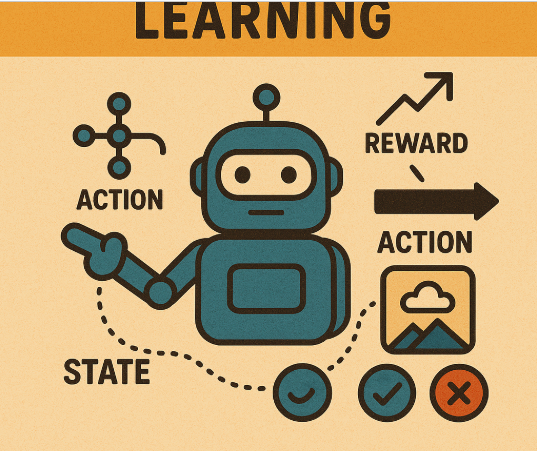
This course introduces reinforcement learning, covering fundamental concepts, key algorithms such as Q-learning, SARSA, and DQN and practical solutions for complex decision-making tasks using appropriate tools and techniques.
- Explain the basic concepts and principles of reinforcement learning, including agents, environments, rewards, and policies.
- Apply key reinforcement learning algorithms such as Q-learning, SARSA, and deep Q-networks (DQN) to solve practical problems.
- Evaluate and compare reinforcement learning algorithms in terms of efficiency, convergence, and performance in real-world tasks.
- Design and implement reinforcement learning solutions for complex decision-making problems using suitable tools and techniques.
Introduction to Reinforcement Learning: key concepts of agents, environments, actions, rewards, policies, states, and value functions; followed by Foundations of Reinforcement Learning: Markov Decision Processes (MDPs), Bellman equations, reward signals, policy evaluation, policy improvement, and optimality; next, Core Reinforcement Learning Algorithms: value iteration, policy iteration, Q-learning, SARSA, Monte Carlo methods; Deep Reinforcement Learning: deep Q-networks (DQN), policy gradient methods, actor-critic models, and applications of deep learning to RL; the course will also cover Exploration vs. Exploitation: epsilon-greedy strategy, Upper Confidence Bound (UCB), Thompson sampling, and exploration strategies; Advanced Topics in Reinforcement Learning: multi-agent systems, inverse reinforcement learning, continuous action spaces, and applications in robotics, game playing, and autonomous vehicles.